Welcome to my stamp blog

Welcome to my stamp blog
Feel free to leave comments!

Friday, August 25, 2017

Fun With Philatelic Material - Olympic Gold Medalist to Tarzan!

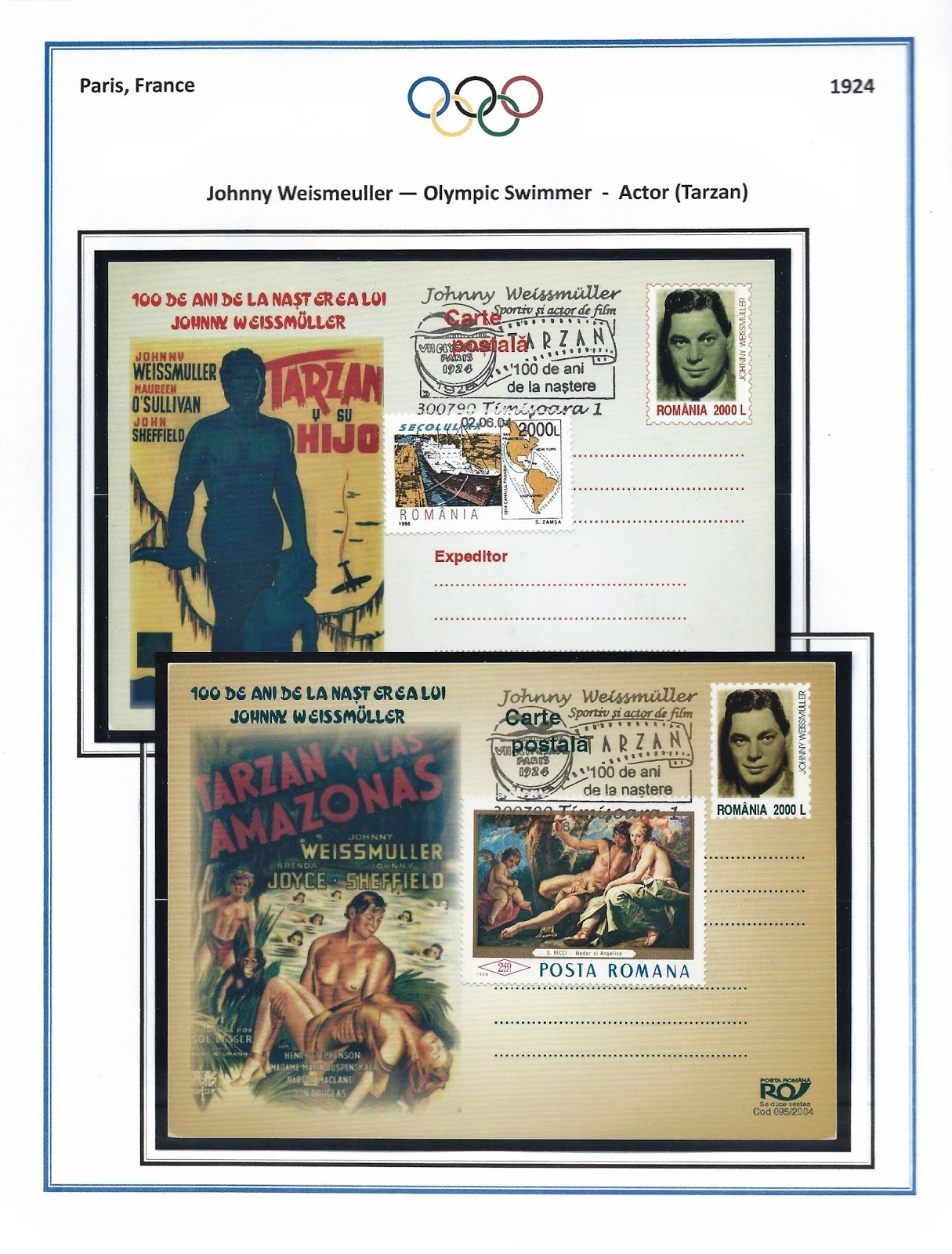
Sometimes it's fun when I run across philatelic materials that illustrate part of my collection where the subject takes a strange twist. Such was the case with the stamp from the Isle of Man that commemorated Johnny Weismeuller's Olympic achievements in the 1924 and 1928 Olympic Games.

I never new he was an Olympic gold medalist! I knew about him since I was a little boy because my father loved to watch him in his Tarzan movies late at night. He and I would sit together in the dark and watch late into the night on Saturday. Weismeuller's parents were from Banat, Yugoslavia where my father was raised.


Later I found this First Day Cover issued in Romania in 2004 to commemorate his achievements.


Johnny Weismeuller was born June 2, 1904 as an ethnic German, the elder son of Peter and Elisabeth, both Banat Swabians. His generally accepted birthplace is in Freiodorf, Austro-Hungarian Empire. 

At the age of 9 Johnny contracted polio and at the suggestion of his doctor, took up swimming to help battle the disease. Weismeuller was swimming's first superstar; swimming the 100m freestyle and the 4x200m relay team event at both the 1924 Paris and 1928 Amsterdam Games. He also won gold in the 400m freestyle.

On the cache, postmark, and stamp, this FDC Romania commemorated his Olympic achievements as well as his transition to the Tarzan roles in multiple Hollywood films.

The following postcards were also issued with caches from various Tarzan movie posters.


Thursday, August 24, 2017

Olympic Torch Relay


In contrast to the Olympic Flame proper, the Torch Relay of the modern Olympic Games, which transports the Olympic Flame from Greece to the various designated sites of the Olympic Games, has no ancient precedent and was introduced by Carl Diem at the 1936 Olympic Games in Berlin.


Ghana - 1964 Tokyo Summer Olympic Games
Isle of Man - 1948 London Summer Olympic Games
Cambodia - 1968 Mexico Summer Olympic Games


Turkey - 1964 Tokyo Summer Olympic Games
Austria - 1972 Munich Summer Olympic Games

This is what the page in my album looks like:


While most of the time the Olympic Torch is still carried by runners, it has been transported in many different ways including, by dragon boat in Hong Kong, by airplane, on horseback, and as a radio signal transmitted by satellite to trigger a laser beam to relight the flame. It has even been carried under water by divers, in an outrigger canoe, on a camel, and on the Concorde.


In this souvenir sheet featuring Pierre de Coubertin, the founder of the modern Olympic Games, the stamp shows the Olympic Flame arriving in the Cook Islands, May 31st 2000, being transported aboard a traditional outrigger canoe with islanders dressed in native costumes.


Monsterrat - 1932 and 1984 Los Angeles Summer Olympic Games
Netherlands - 1968 Mexico Summer Olympic Games


Germany - 1952 Helsinki Summer Olympic Games
German Democratic Republic - 1956 Melbourne Summer Olympic Games

And here is the page in my album:


On its first journey to the southern hemisphere the flame was carried by runners from Olympia to Athens. When the torch reached Athens it was transferred to a miner's lamp and put on board the Qantas Airlines Super Constellation VH-EAB Southern Horizon under Captain Andy Young and given safe passage to Darwin, its first stop in Australia. The flight also carried 440 pounds of souvenir mail of which this cover was one of the 33,116 items flown.


The cover was postmarked at Olympia on 2 November 1956, and then received a special back stamp on arrival at the Olympic Stadium in Melbourne on 22 November 1956,

This is the page in my album:


The 1984 Summer Olympics Torch Relay was run from May 8th until July 28th, prior to the 1984 Summer Olympics in Los Angeles. The route covered about 9,300 miles across the United States and involved over 3,600 torch bearers.


This postcard with a First Day of Issue cancellation in Los Angeles, also has the Olympic Torch runner as part of the imprinted stamp. The cache features two Olympic Torch runners handing off the Olympic Torch.


Ghana - 1960 Rome Summer Olympic Games

The 1960 Rome Olympic Games Torch Relay started at Olympia then went through many ancient cities including Pyrgos, Patras, Megara, Eleusis, and Athens, from the Panathinakos Stadium in the Greek capitol, to Syracuse in Italy, and along the Appian Way, the Forums, and on to the Olympic stadium.

And finally, this is what the page looks like in my album.


My collection of Olympic Torch Relay stamps and pages will continue to grow as a unique subset of my collection, and part of the Olympic Games story told in stamps.

Wednesday, February 8, 2017

International Olympic Committee Presidents

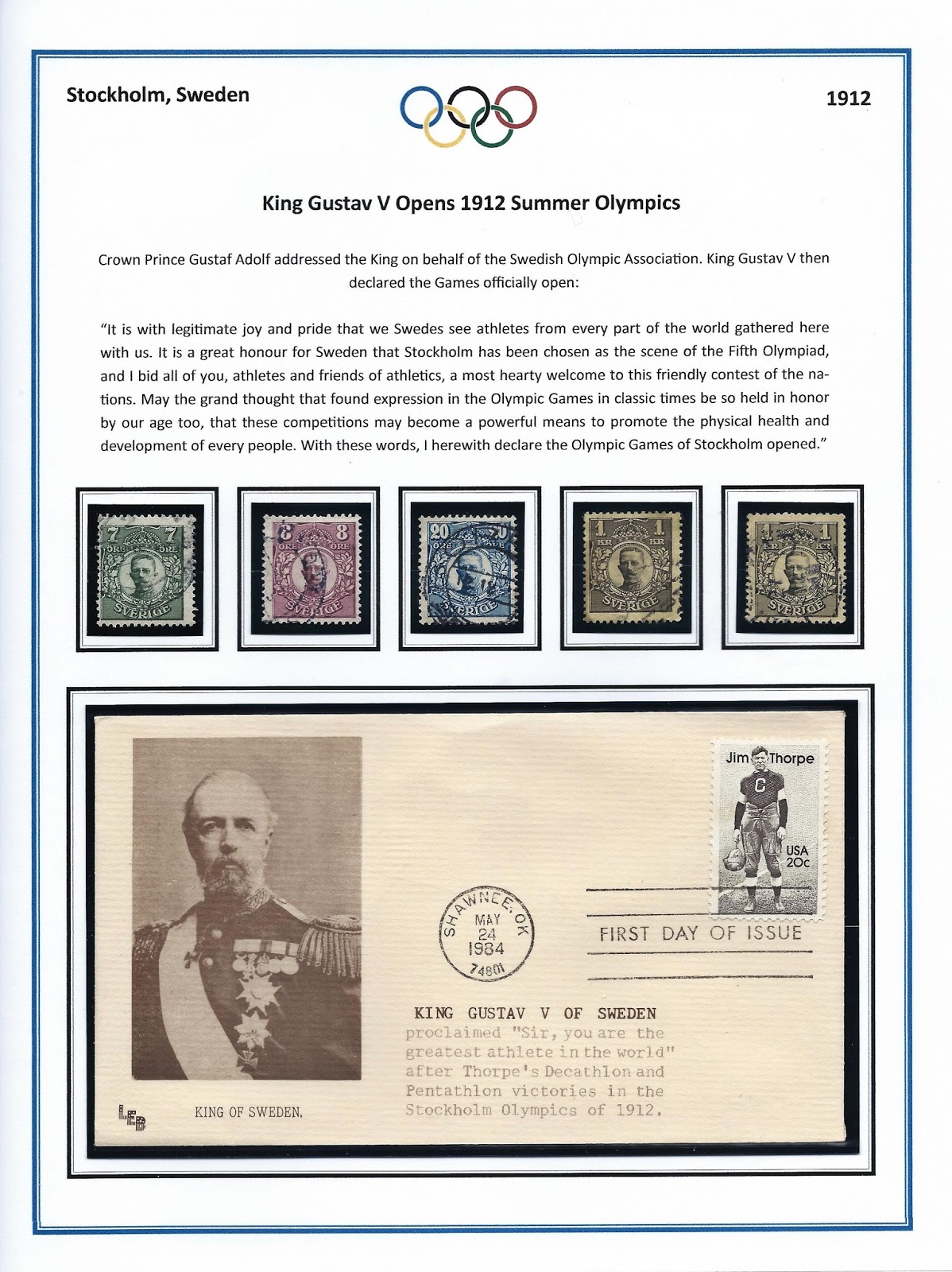
My last post highlighted the King of Sweden opening the 1912 Summer Olympic games and the stamps and cover I bought to illustrate that part of the Olympic event.

Today I want to highlight stamps picturing the International Olympic Committee presidents from the beginning of the Modern Olympic Games. There has always been an elected president of the International Olympic Committee since Pierre de Coubertin founded the Olympics in 1894.

San Marino issued a set of stamps commemorating the first seven presidents. While not as colorful or as interesting as the Olympic sports stamps, they are still stamps that have been issued that are part of the story of the Olympics.

1. Demetrius Vikelas
(1894–1896)
2. Pierre de Coubertin
(1896–1925)
3. Henri de Baillet-Latour
(1925–1942)


4. Sigfrid Edström
(1942–1952) 
5. Avery Brundage
(1952–1972)
6. Lord Killanin
(1972–1980)


7. Juan Antonio Samaranch
(1980–2001)

 
And here is a picture of the page I created to display them.


While Pierre de Coubertin founded the Modern Olympics he was originally the General Secretary of the first International Olympic Committee. Demetrius Vikelas was the first IOC president, but only served for two years. Pierre de Coubertin served from 1896 until 1925. Coubertin was later elected as honorary president of the IOC until he died in 1937.

IOC presidents I don't have stamps for are: Jacques Rogge who served from 2001 to 2013; and Thomas Bach the current IOC president who has served since 2013.

Tuesday, February 7, 2017

King Gustav V Opens 1912 Summer Olympics

Part of the development of my stamp collection has become telling the story of the Olympic Games through stamps, postmark cancellations, and first day covers. Telling the story sometimes goes beyond just collecting "Olympic" stamps. It now includes adding stamps that commemorate the associated events and people connected with the Olympic Games.

For example, I discovered this First Day Cover featuring the US stamp commemorating Jim Thorpe the most decorated athlete of the 1912 games in Stockholm, Sweden. But it wasn't the stamp that drew me to the cover. It was the cache depicting King Gustav V who officially opened the 1912 Summer Olympic Games.

The cache was designed by Lorraine Bailey, a cache maker in the Washington, DC. area.


Then I searched for stamps commemorating King Gustav V and found several. I bought these five that were issued in 1911 to 1919 adding them to my collection and creating this new page.


Monday, January 30, 2017

The Olympic Hymn


The Olympic Hymn is a choral cantata written in 1894, and performed for the first time during the opening ceremony of the first Olympic Summer Games in 1896 in  Athens, Greece. The International Olympic Committee declared it the official Olympic Anthem in 1958 and has been performed at every Olympic Games since 1960 during the opening and closing ceremonies when the Olympic flag is raised and lowered.


The hymn was written by Greek opera composer Spyridon Samaras, and the lyrics by Greek poet Kostis Palamas. Both poet and composer were selected by Dimetrius Vikelas, the first president of the International Olympic Committee.


Olympian flame immortal
Whose beacon lights our way
Emblaze our hearts with the fires of hope
On this momentous day
As now we come across the world
To share these Games of old
Let all the flags of every land
In brotherhood unfold
Sing out each nation, voices strong
Rise up in harmony
All hail our brave Olympians
With strains of victory
Olympic light burn on and on
O'er seas and mountains and plains
Unite, inspire, bring honor
To these ascending games
May valor reign victorious
Along the path of golden way
As tomorrow's new champions now come forth
Rising to the fervent spirit of the game
Let splendour pervade each noble deed
Crowned with glory and fame
And let fraternity and fellowship
Surround the soul of every nation
Oh flame, eternal in your firmament so bright
Illuminate us with your everlasting light
That grace and beauty and magnificence
Shine like the sun
Blazing above
Bestow on us your honor, truth and love

Friday, January 27, 2017

Role of Art in the Olympics

Pierre de Coubertin believed that sport was an aesthetic experience for both athletes and spectators alike. He conceived of the modern Olympic Games as a spectacle that would demonstrate the harmony that existed between sport and art. He called this ideal "eurythmie".


In May 1906 Baron de Coubertin organized a meeting in Paris for both IOC members and representatives of artists' organizations. The meeting ended with a proposal to the IOC to organize artistic competitions at the Olympic Games in five areas - architecture, literature, music, painting, and sculpture. The works of art that were entered had to be inspired by sports.


The Modern Olympic Games became distinguished as a modern spectacle where fine art and folk art merged aesthetically with a large international sport competition. Host cities shared their distinctive cultural heritage with international visitors.


Art competitions formed part of the modern Olympic Games from 1912 until 1948. Medals were awarded for art inspired by sport in the five categories mentioned along side the medals awarded in athletic competition. These juried art competitions were, however, abandoned in 1954 because artists came to be considered 'professionals', while Olympic athletes were required to be 'amateurs'.

Since 1956 the 'Olympic Cultural Program' has taken their place. Art festivals are held all over the Olympic host cities every four years. Unfortunately, the media never mentions them.

Since I learned about this aspect of the Olympics, I have begun adding Olympic stamps that feature art in connection with sport to my collection.

Monday, December 19, 2016

From Kitty Hawk to the International Space Station!

It's been almost a month since I posted anything new here. I thought it was high time! I hope you think so too! But instead of writing about my Olympic stamp collection, I thought I'd write a little bit about my Space Exploration Collection.

Since I found Hipstamp.com I have been really spending a LOT of time building my collections! In the past it was difficult to know where to get stamps I wanted or needed for my collection. Now, at Hipstamp I can search for specific stamps by Scott Catalog number, Topic, or country. This has really become fun! Going to the mail box each day as the stamps I purchase arrive is like having a little bit of Christmas everyday!

Anyway, I renamed my collection. I originally called it "From Kitty Hawk to Tranquility Base" from the information I discovered at the Wright Brother's Museum about a piece of the original Wright flyer being taken to the moon by Neil Armstrong. But I realized that the space program continued way beyond the moon landing. So I call my space collection "From Kitty Hawk to the International Space Station".

In past years I was never much of a First Day Cover collector, but now I've been adding more and more FDCs to my collection. I really like the way it looks!


This page features the US issue in 2003 celebrating the centennial of the first controlled powered flight by the Wright brothers. Then I began looking for a FDC to go along with the Sheet of stamps. I found this one with a cache of the Wright brothers and their take off at Kill Devil Hills, North Carolina. The stamp obviously matches the sheet and the post mark that can be seen in the picture is from Kill Devil Hills. 
But if you look closely at the rest of the postmark you can see the Wright flyer in the middle, the Space Shuttle to the left, and the Apollo Space Capsule to the right. For me that tied the maiden flight to the moon landing and beyond! As soon as I saw that FDC I knew I wanted it for my collection!